
In addition to fundraising oversight, the Federal Election Commission governs how RPAC funds are to be transmitted to Georgia RPAC and then forwarded to National RPAC. The information presented here addresses some of the most common legal situations encountered when handling RPAC funds. If you can’t find the answer to your question or need additional guidance on a particular topic, please contact the GAR Advocacy Team.
How does a local association collect RPAC investments?
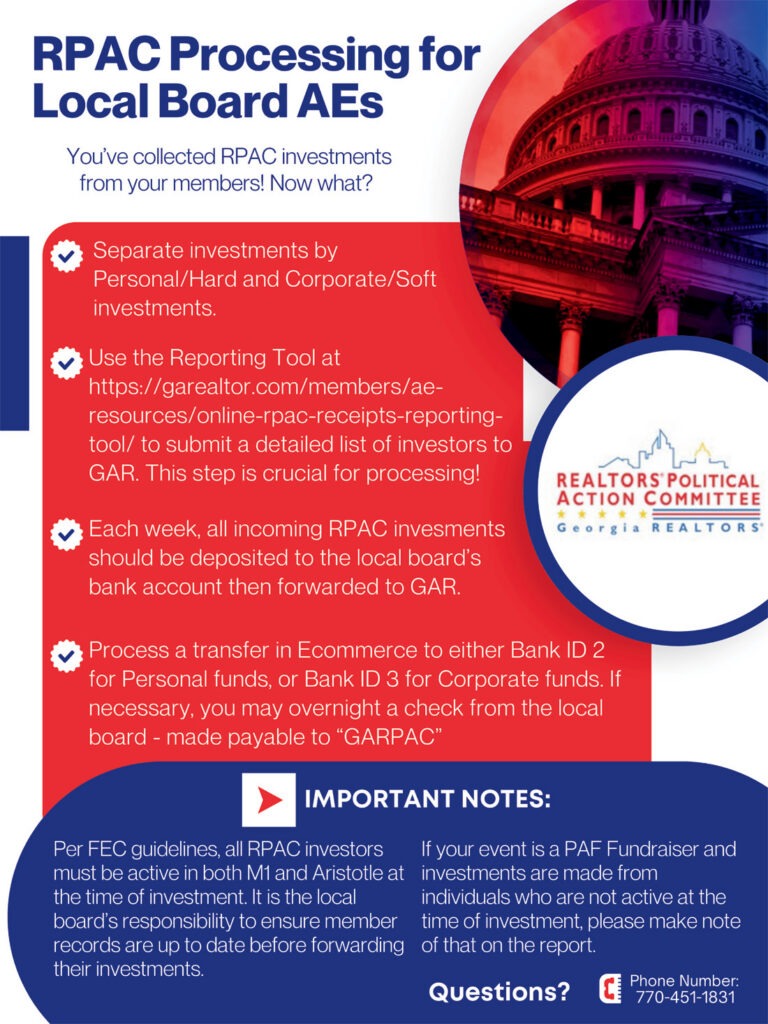
RPAC investments can be made by check (payable to “Georgia RPAC”) or by personal credit or debit card through an online platform (such as Aristotle, RAMCO or GrowthZone). Some associations continue to accept physical cash as well. For cash and checks, the preferred process is for the local association to deposit those funds in its standard bank account, then transfer the money to Georgia RPAC via the NAR eCommerce platform. All RPAC transfers need to be accompanied by a report that clearly identifies the investors and the amounts invested. It’s recommended that local associations also document the date of receipt for all RPAC investments and retain said documentation for future reference.
RPAC Processing Guide for Local AEs
RPAC Processing for Local Boards (download PDF)

Can a member make an RPAC investment in December for the coming year?
Only RPAC investments associated with dues billing can be designated for the same recognition year as the dues. An RPAC investment made at any other time (at a board fundraiser, via the GAR website, etc.) must be designated for the year in which it was received. When the local association is sending funds to Georgia RPAC, they should be separated based on the recognition year.
What are the Transmittal Time Limits for RPAC Investments?
Under federal law, there are strict time limits for forwarding RPAC investments to Georgia RPAC and then to National RPAC.
To guarantee proper adherence to these time limits, local associations should transfer RPAC funds to Georgia RPAC weekly. Do not hold RPAC investments; make it standard operating procedure to process and forward all funds EVERY WEEK.
What’s the difference between “Hard Funds” and “Soft Funds”?
Hard funds (or personal funds) are voluntary investments made by individuals with a personal check or credit card paid with personal funds. These are the only funds that can be contributed to federal candidates. Hard dollars are regulated by the Federal Election Commission, and a person is limited to a maximum investment of $5,000.00 per year. Both National RPAC and the NAR President’s Circle can only accept hard funds.
Soft funds (or corporate funds) are investments made by organizations and incorporated businesses. Soft dollars are not regulated by the FEC but can’t be given to federal PACs or candidates. However, through NAR’s Corporate Ally Program (CAP) and Political Advocacy Fund (PAF), these funds can be used to support NAR’s political involvement through issue advocacy, independent expenditures, Opportunity Race communications, and community outreach efforts.
At the state level, Georgia law does not distinguish between hard and soft dollars – both types of funds can be directly given to candidates for local and state elected office. However, Georgia RPAC must receive and process hard funds differently than soft funds to ensure that contributions are properly forwarded to NAR. It is very important to identify each investment as hard or soft and to submit them to Georgia RPAC in separate batches.
Both hard and soft funds are counted for individual investor recognition purposes.
Online RPAC Processing via Aristotle
NAR uses Aristotle’s PAC management platform to track RPAC fundraising nationwide. Aristotle also provides associations with an easy online method for accepting RPAC investments. The benefits of using a customizable webform include:
- Immediate processing of transactions by credit card
- Safe and secure transfer of funds (no handling of cash or mailing checks)
- Direct forwarding to state and national RPAC (no additional processing needed)
Contact the GAR Advocacy Team to learn more about online fundraising.
RPAC Online Posting Guidelines
Click here for more information.
RPAC Legal & Tax Resources
Click here for more information.